Meeting Defense Transportation Cargo Movement Regulations – Part I
In this Blog we’ll be taking a look from time to time at regulations which affect the markets that OpticalLock participates in. In this post we’ll be reviewing a specific area of the Document “Joint Publication 4-01 The Defense Department Transportation System“. This is a massive, daunting document on defense transportation and there are many sections of it that are ripe for discussion. The focus of our discussion will be on CHAPTER IV: EMPLOYMENT OF THE DEFENSE TRANSPORTATION SYSTEM.
Even this section is voluminous with a great deal of detail. Today we’ll focus on Section 5: “In-Transit Visibility Reporting” and Section 6″ “Layering of Automated Identification Technology to Promote Asset and In-Transit Visibility“, which are most relevant to OpticalLock’s upcoming products. Below is the content of sections 5a and 5b:
5. Defense Transportation Visibility Reporting of In-Transit Cargo
a. Integrated Data Environment/Global Transportation Network Convergence (IGC). IGC is a single system that integrates information from a variety of DTS automated information systems to provide ITV and C2 data support. IGC supports the President, SecDef, the CCDRs, the Services, and other DOD customers with information to better manage their warfighting and logistic capabilities. IGC is the ITV system of record providing expanded common integrated data and application services enabling distribution solutions. IGC enables a common logistics picture, distribution visibility, and material asset/ITV.
b. ITV is the ability to track the identity, status, and location of DOD units, non-unit cargo (excluding bulk POL), passengers, patients, and personal property from origin to consignee or destination across the range of military operations. ITV of assets moving through DTS or in support of DOD operations is an essential element of the DOD
warfighting capability and is required by the supported CCDRs. The transportation tracking number (TTN) and transportation control number (TCN) are alphanumeric character sets assigned to a shipment (unit move and sustainment) to maintain ITV. IGC links the TCN to the military standard requisitioning and issue procedure (MILSTRIP) number, if available, and to commercial express carrier tracking numbers, if applicable. The Defense Logistics Management System (DLMS) establishes a baseline set of data necessary to support information exchange technology, such as manifests, electronic data interchange (EDI), and automated identification technology (AIT) devices. Service-specific logistics systems apply
DLMS standards to enable movement data which is consolidated in IGC. Users can query various ITV data relevant to their cargo in IGC. IGC also provides cargo detail to various common operational pictures, such as the Single Mobility System, the Battled Command
Support and Sustainment System, and others. The TTN will link ITV data to JOPES in support of OPLAN execution. This gives the user multiple ways to track forces, equipment, and items. See the Defense Transportation Regulation for specific information governing the use of TTNs and TCNs.
The importance of this section as it relates to OpticalLock is that it explains the key role that tracking data plays in managing DOD shipments. The OpticalLock SmartLock fits extremely well into the IGC/ITV ecosystem detailed in these sections. Not only does the OpticalLock system provide real-time alerting and tracking information on the lock and associated cargo, but also will provide storage and reporting of a body of rich location and tampering data generated by OpticalLock sensors. This can serve as a detailed audit trail for a variety of applications.Let’s move on to Sections 6a and 6b:
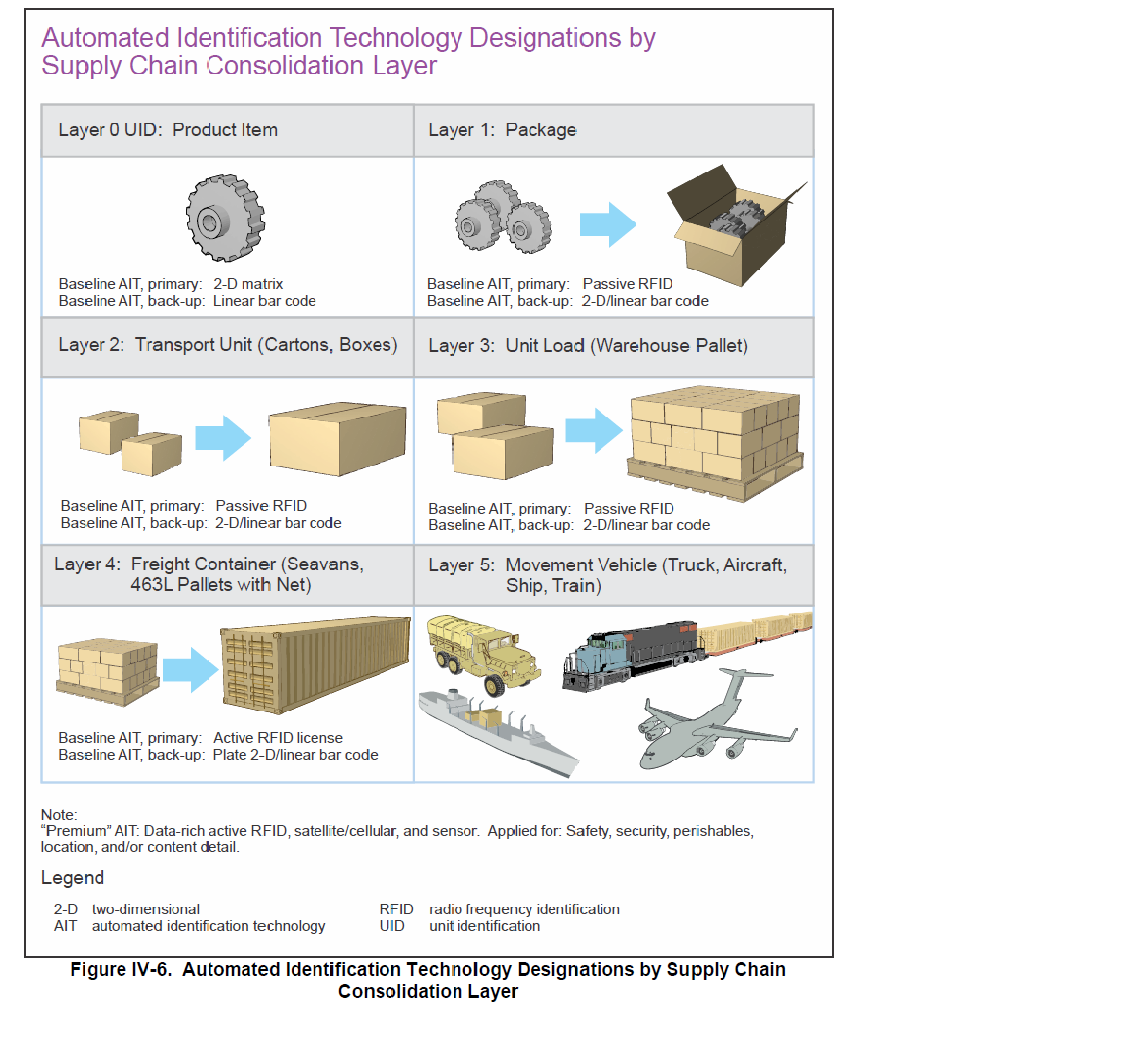
6.Layering of Automated Identification Technology to Promote Asset and In-Transit Visibility
a. Automated Identification Technology. AIT is a suite of technologies enabling the automatic capture of data, thereby enhancing the ability to identify, track, document, and control materiel, deploying and redeploying forces, equipment, personnel, and sustainment cargo. AIT encompasses a variety of data storage or carrier technologies,such as bar codes,magnetic strips, integrated circuit cards, optical laser discs (optical memory cards or compact Employment of the Defense Transportation System IV-15 discs), satellite tracking, and radio frequency identification (RFID) tags used for marking or“tagging” individual items, equipment, air pallets, or containers. The consistent application of AIT in the distribution and supply chain processes throughout DOD is key to deriving the most asset visibility and ITV in the DOD enterprise.